

Abraham Kuyper’s influences and those he influenced
Review of "The Legacy of Abraham Kuyper" by Harry Van Dyke.

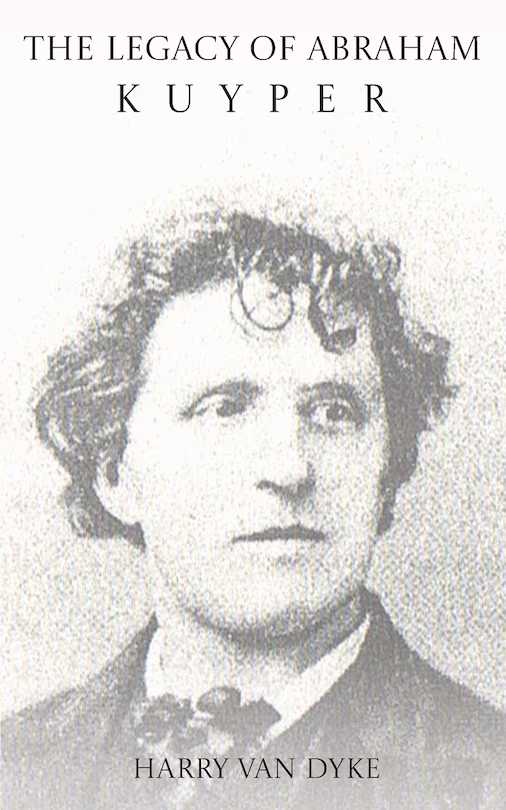
The Legacy of Abraham Kuyper
Harry Van Dyke
WordBridge, 2024.
Harry van Dyke’s book was triggered by a conference commemorating the hundredth anniversary of Kuyper’s 1898 Princeton Stone Lectures on Calvinism. Centenary speakers presented Kuyper as unprecedented. In The Legacy of Abraham Kuyper, Van Dyke considers key individuals who influenced Kuyper and as many leaders whom Kuyper influenced.
Significant influencers
The book’s first part discusses individuals who shaped Kuyper, including three men who shaped him ideologically and theologically: Willem Bilderdijk (d. 1831), Isaac da Costa (d. 1860), a convert from Judaism, and Guillaume Groen van Prinsteren (d. 1876). All three rejected eighteenth-century Enlightenment assertions that accepted the existence of God (or some deity) but regarded humans as autonomous. In the nineteenth century, the Enlightenment gained a considerable foothold among the Dutch Reformed Church’s “upper crust” and clergy, including Kuyper’s father, a theologically liberal pastor. Many church members among the lower classes, however, remained faithful to orthodox Calvinism.
Da Costa held that orthodox Calvinists had to organize against modernists in the church, and he launched a revival movement named Réveil. Groen joined this movement, becoming its leading figure and inspiration. He worked out a plan to organize the orthodox faithful against church modernists, with two principal parts: a political organization and a separate Christian school system. Later, he also became convinced of the need to establish a free church, since the Dutch Reformed Church was a state church. Kuyper was won over by the Réveil and its objectives and eventually made all three priorities a reality. Two lesser-known figures, Otto Gerhard Heldring and Johan Adam Wormser, supported Groen’s objectives and also impacted Kuyper. Kuyper became an effective communicator through writing for two periodicals, De Standaard and De Heraut. From Klaas Kater (d. 1916), he learned how to win the support of working-class orthodox Calvinists.
Between his twenty-fifth and thirtieth years, he experienced a profound personal and religious conversion. Jeroen Koch, a recent Kuyper biographer, says that this period transformed Kuyper from liberal theology into orthodox Calvinism. His profound spiritual transformation made him the driven reformer that he became. Without it, we might never have heard of him.
Kuyper cited his renewed study of Calvin as an important factor in his conversion; his doctoral dissertation was on Calvin. Yet even more than by Calvin, he was affected by the conversion account of a character in British writer Charlotte M. Yonge’s novel The Heir of Redcliffe, a book recommended to Kuyper by his fiancée, Johanna Schaay. Only the Bible had more meaning for him.
Another significant role was played by the country folk of Beesd, his first pastoral charge, who clung to orthodox and pietistic Calvinism. Years later, when writing her obituary, Kuyper singled out Petronella (Pietje) Baltus from other Beesd parishioners as having most influenced and inspired him.
Seven influenced
The book’s second part briefly discusses seven men who, in various fields, made a substantial impact consistent with Kuyper’s ideas and in his spirit. These individuals include Herman Dooyeweerd, who constructed a neo-scholastic neo-Calvinism.
Two men introduced a more ethical colonial policy in what is now Indonesia. Others influenced by him worked to improve the social and economic conditions of the lower classes, to widen the voting franchise, to obtain funding for private schools, to oppose the threat posed by National Socialism in the Netherlands, and to offer legal advice to combat measures taken by Nazi occupiers during the Second World War. Through the contributions of such individuals, Kuyper indirectly impacted many thousands of people.
Kuyper was more than the sum of those who influenced him: he took their ideas and fashioned them into a coherent ideology and system that in turn, inspired many others.



I’ve read somewhere that Bavinck broke with Kuyper and wonder if that is accurate and if the book includes this.