

Creativity as a spiritual discipline
Review of "The Discipline of Inspiration" by Carey Wallace.

The Discipline of Inspiration: The Mysterious Encounter with God at the Heart of Creativity
Carey Wallace
Eerdmans, 2025.
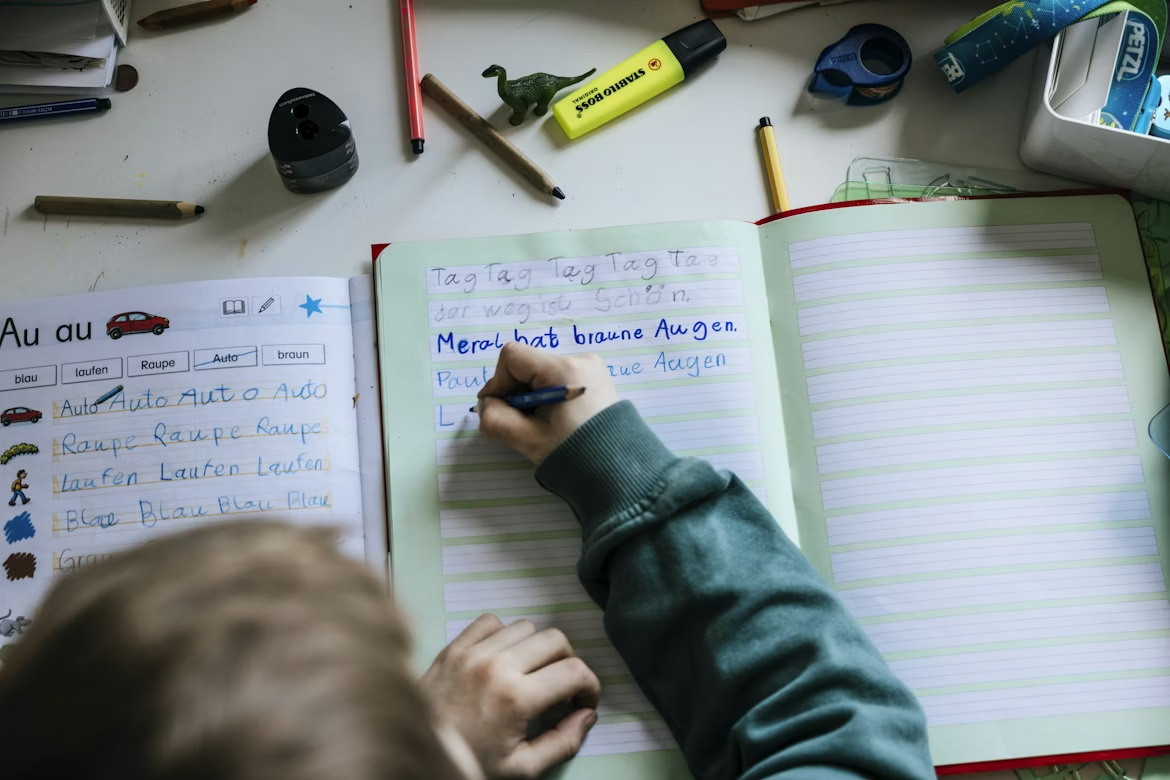
At four years of age, I decided to learn how to write. I sprawled on the living room carpet, placed a blank page over a flattened Smarties box, and traced the letters. Then I ran to the kitchen, triumphantly presenting the sheet to my mother, exclaiming, “I can write!” She observed, “You copied a Smarties box.” How did she know? I wondered. I needed another plan. Before stepping out our back door, on my first day of kindergarten, I proclaimed to my parents: “Today I’ll learn to write.” Sixty-plus years later, still learning to write, I am more and more curious as to why I want to write.
‘Art comes from God’
Carey Wallace, author and songwriter, explores creativity and inspiration as divine gifts. Our urges to paint, decorate, garden, write, bake, woodwork, make music, knit or quilt are part of being made in the image of God who created heaven and earth. In fact, Wallace insists that “art comes from God” and “flows from something beyond our understanding.” Not all cultural products (e.g. propaganda, pornography) are art but creativity is part of our mandate to make and mend on God’s behalf here on earth.
Drawing on her impressive artistic skills and experiences, Wallace encourages all of us to be creative. She bolsters her claims by citing: Bach, Emily Dickinson, Raymond Carver, Jack London, Johnny Cash, Otis Redding, Harper Lee, Virginia Woolf, Frida Kahlo, Mavis Staples, Aretha Franklin, Stevie Wonder, Mozart and more.
Her reflections are immensely encouraging. This book is the Christian equivalent to Rick Rubin’s masterful The Creative Act: A Way of Being (Penguin, 2023). She reminds us that even failure is not wasted in God’s economy and likewise cautions against worshipping artists or relying on praise. That’s a relief! She reassures that art is made by imperfect people.
Meaningful lives
Wallace shows her readers that inspiration is not only about spiritual jollies. Pain might in fact motivate one to create: “It is no secret that heartache spurs creation.” I know that a primary need for PTSD survivors is being heard before being able to be healed. Affliction can help us see new possibilities.
Wallace encourages us to see that arts and crafts, making and creating, can be a spiritual discipline. Not only do we improve the world, we also build meaningful lives.
I like her insistence that art is evidence of “the stubborn persistence of God among us, among broken and evil things.” That is why many feel that art gives “a glimpse of God.” No wonder that in museums people often move quietly, staying hushed, as if in a great cathedral.
I have many things to celebrate about having been a pastor for four decades. I cherished visiting homes and being astonished by people’s creations: delicious meals, elaborate embroidery, colourful quilts, fine woodworking, delicate hand-carvings, staggering sculptures, elegant musical instruments, evocative paintings, delightfully arranged homes and on and on. These not only celebrate the productivity of talented individuals they also give glory to God.
I certainly hope that is why I still feel compelled to write; that determined four-year-old was onto something.


